
Market Supply
Aluminium Windows and Doors for New Zealand: Wind, UV and Salt Air
New Zealand puts three loads on a window at once. Marine air reaches most of the population, UV is strong enough to punish a thin coating, and wind-driven rain on an exposed coast finds every gap in a seal. The wind side is where the local framework matters, since New Zealand and Australia share the joint AS/NZS standards for wind pressure and glass selection. Adam Alux Systems has built aluminium windows and doors since 1997 at three bases in China, and quotes New Zealand work against the wind and glazing requirements of the project.

NEW ZEALAND · COVERED DECK
Working inside the AS/NZS frame
New Zealand projects run on the joint AS/NZS system: AS 2047 sets the wind pressure basis for the window, and AS 1288 covers glass selection and thickness. A designer turns those into a wind zone and a glass type on the schedule, and the supplier builds to that. Adam Alux holds no New Zealand specific listing, so the engineering is confirmed against the project at quotation.
What the factory brings to that conversation is the extrusion and the build: a 2.0 mm wall on the 118 and 112 casement lines, stainless-steel rails on the heavy sliders, and EPDM foam gaskets through the range.
Series for New Zealand openings
The 112 casement window is the common starting point on residential work: five chambers, a 2.0 mm wall, and a flush-line sash that sits level with the wall. The 118 casement window adds a sixth chamber and a 5-27 A-5 unit for tall lights on an exposed elevation.
Where the frame should read light, the 50 casement window runs a 50 mm frame at 1.2 mm with 5-20 A-5 glass and a high-transparency screen. Wide horizontal openings go to the 95 sliding window on 2 or 3 tracks with ball-bearing rollers and a 1.4 mm wall.
Coating under high UV
UV fades a weak coating from the top face down, and on the coast salt works at the same edge. Fluorocarbon holds both, which is why it turns up on coastal specification sheets. Anodised and thermal transfer are the other two finishes, with RAL matching and two-tone faces on request, exterior one colour and interior another.
Hardware follows the exposure: stainless-steel rails on the sliding doors, keyed handles and multi-point locking on the casements. A finish chosen for an inland site often reads differently at the coast, so the choice is made against the site.
Rain, drainage and air
Wind-driven rain arrives at an angle, so the seal has to work with the drainage. Adam Alux frames drain through an open self-draining path at the sill, and the EPDM foam gasket compresses across the sash rebate. Water that gets past the outer line leaves by the sill instead of sitting in the profile.
Ventilation is the other half of a New Zealand build, since indoor humidity has to go somewhere. The casement range opens on a side hinge and holds a wide aperture on a friction stay.
Starting a New Zealand order
A New Zealand enquiry needs the opening sizes, the unit count, the destination port and the wind zone the project sits in. Auckland, Tauranga and Lyttelton take the containers. The quotation comes back with a dimensional pack on PDF, CAD on request, and the glazing build-up written against each elevation. A sample profile set and one finished test window can be sent for inspection.
FAQ
Frequently asked
Does Adam Alux hold New Zealand product certification?
No New Zealand listing is held. The single attestation is CE to EN 14351-1, no. M.2024.206.C101817, issued by UDEM. New Zealand schedules that cite the joint AS/NZS framework are worked through at quotation, where the wind pressure requirement and the glass selection are matched to the extrusion and the build-up.
Which series suits an exposed coastal elevation?
The 118 casement window is built for that position: six chambers, a 2.0 mm wall, and a 5-27 A-5 unit, the widest cavity in the range. The 112 casement window does similar work on five chambers with a flush-line sash. Both take multi-point locking as standard, and the wind pressure requirement is checked against the opening at quotation.
What glazing comes with the windows?
5-20 A-5 insulating glass is standard across the window range, with single or triple builds on request; the 118 line goes to 5-27 A-5. On a New Zealand build the glass choice follows the AS 1288 selection for the elevation, so the build-up is written per opening at quotation. Clear, frosted, reeded, fluted and coated options are available.
How does the finish handle UV and salt together?
Fluorocarbon holds colour and edge coverage where UV and salt arrive together, which covers most coastal work. Anodised and thermal transfer are the alternatives, and all three take RAL matching with two-tone faces on request. The finish is confirmed against physical swatches at quotation, since a colour that reads right indoors can shift on a north face.
Can the frames handle wind-driven rain?
The frame drains through an open self-draining path at the sill, so water that passes the outer gasket leaves the profile. EPDM foam gaskets run the full sash rebate. On exposed sites the drainage and the fixing detail carry as much weight as the profile, so both are reviewed against the project at quotation.
Reference projects in comparable climates
villa · day scene
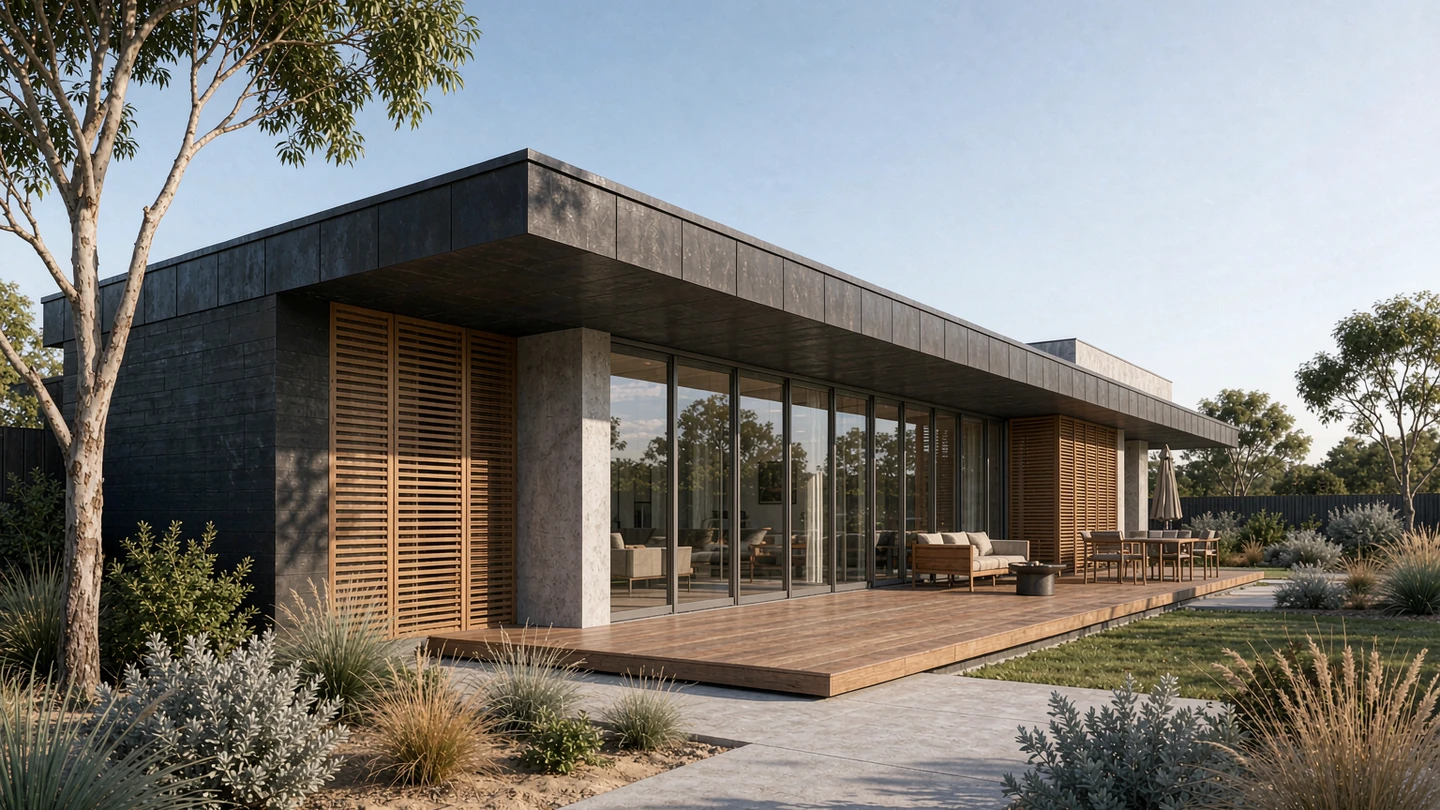
House with deep eave, timber screens
A wide overhanging roof shades sliding doors that open the living area onto a timber deck.
villa · day scene
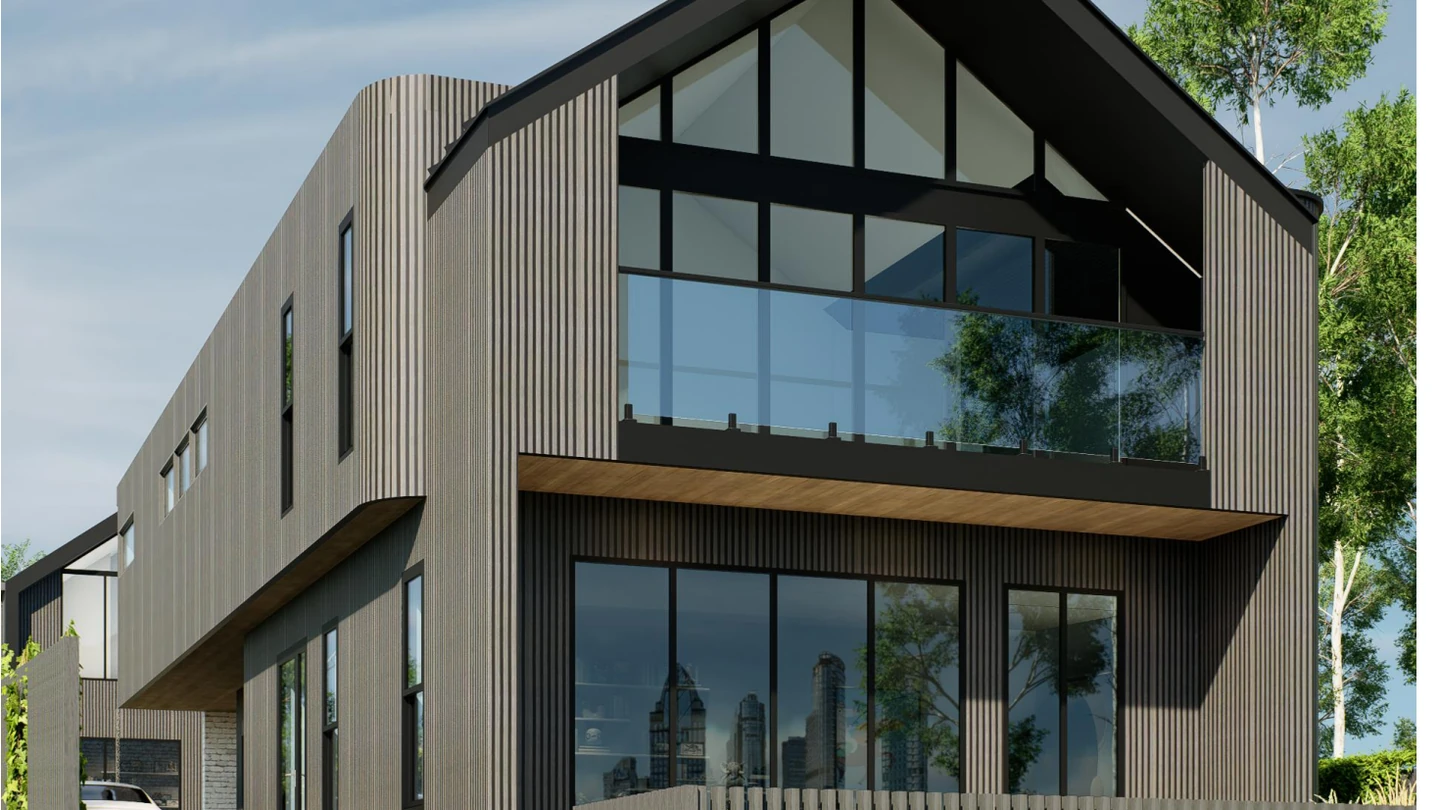
Dark-clad villa, timber slat screens
Dark-clad street villa with timber slat screens and a corner sauna pavilion.

villa · day scene
Coastal house, full-height glazing
A raised concrete deck and full-height glazing turn the elevation toward the water, under a deep shaded veranda.
Send your opening schedule
Series, glazing and finish come back as one quotation, with the full dimensional pack on PDF and CAD on request.