
Market Supply
Aluminium Windows and Doors for the Philippines: Typhoon Season and Salt Air
Philippine work runs on two clocks. Humidity is constant, so the frame and the seal are asked to keep weather out all year. Then the typhoon season arrives, roughly June to November, and wind load decides how the unit is fixed and how the glass is held. Salt air along the coast works on the finish in both seasons. Adam Alux Systems has produced aluminium windows and doors since 1997 at three bases in China and quotes Philippine projects from the opening list.
PHILIPPINES · DEEP REVEALS
What a Philippine schedule has to answer
Two questions sit under most Philippine window schedules. The first is water: driving rain at an angle finds any gap that faces the weather, so the sill and the gasket do the work. The second is wind. Typhoon-season pressure is a project calculation, and the fixing, the sash size and the glass thickness follow from it.
Strong-wind work is quoted as a configuration, not picked off a catalogue page. Sash dimensions, reinforcement and glazing are confirmed against the opening at quotation, and the answer changes with the elevation and the height of the building.
Series that fit Philippine buildings
The 50 casement window is the workhorse: a 50 mm frame at 1.2 mm with a 5-20 A-5 unit and a high-transparency insect screen as standard, which counts in a country where the screen is not optional. The 112 casement window takes larger lights on a 2.0 mm wall with five chambers.
Wide openings go to the 95 sliding window on 2 or 3 tracks with ball-bearing rollers, and balcony fronts take the 35x16 narrow-frame sliding door. Panel widths are quoted against the opening, since a wide sash changes the hardware.
Glass and the screen
Insulating glass at 5-20 A-5 is the standard window build, with single or triple units on request. On a Philippine assembly the decision usually turns on solar heat and street noise. A tinted or coated outer pane cuts the radiant load; the cavity handles the rest. Door leaves go out on automotive-grade tempered glass.
The insect screen is standard on the casement range, in a high-transparency mesh. It is a specification item on Philippine work rather than an accessory, and it is priced with the unit.
Salt, drainage and the wet season
Coastal cities put salt on the frames all year, and the wet season adds standing water at the sill. Frames drain through an open self-draining path so water leaves the profile instead of sitting behind a cover strip. EPDM foam gaskets hold their compression through heat and repeated rain.
Fluorocarbon is the finish that lasts on coastal work; anodised and thermal transfer are the other two lines, with RAL matching and two-tone faces on request. Stainless-steel rails go on the heavy sliding doors.
Sending a Philippine enquiry
Four things start a Philippine quotation: the opening sizes, the count per size, the port, and the wind exposure of the site. Manila, Cebu and Iloilo take the containers. A dimensional pack on PDF comes with the quote, CAD on request, plus a sample profile set or one finished test unit before the order. Lead times are confirmed with the quotation.
FAQ
Frequently asked
Is there a Philippine certification for these windows?
None is held. Adam Alux carries one attestation, CE to EN 14351-1, certificate no. M.2024.206.C101817, issued by UDEM. Where a Philippine project names a local approval, the glazing and the fixing detail are confirmed against the project at quotation, and the answer is put in writing before production starts.
How do you handle typhoon-season wind?
As a configuration. Sash size, reinforcement and glass are set against the wind exposure and the height of the opening, then confirmed at quotation. Adam Alux does not claim a hurricane-zone approval of the kind used in the United States; strong-wind builds are quoted per project, and the 112 casement window on a 2.0 mm wall is the usual starting point for exposed elevations.
Which series suits a mid-range house?
The 50 casement window covers most of it: a 50 mm frame at 1.2 mm, 5-20 A-5 glass as standard, multi-point locking, a keyed handle and a high-transparency insect screen. For wider living-room openings the 95 sliding window runs on ball bearings at 1.4 mm, and balcony fronts take the 35x16 narrow-frame slider.
Does the insect screen come as standard?
Yes, on the casement range, in a high-transparency mesh, and it is quoted with the unit. On the sliding range the track and the gasket do more of the sealing work, and EPDM foam gaskets close the sash to the frame. Frames drain through an open self-draining path at the sill, which matters through the wet season.
How is the finish chosen for a coastal site?
Fluorocarbon is the usual answer on Philippine coasts, since salt attacks coating edges and cut ends first. Anodised and thermal transfer run on those same profiles, and RAL matching with two-tone faces is available on request. Swatches are sent before the order, because a finish that looks right on screen reads differently in tropical light.
Reference projects in comparable climates

apartment · day scene
Apartments, recessed balconies
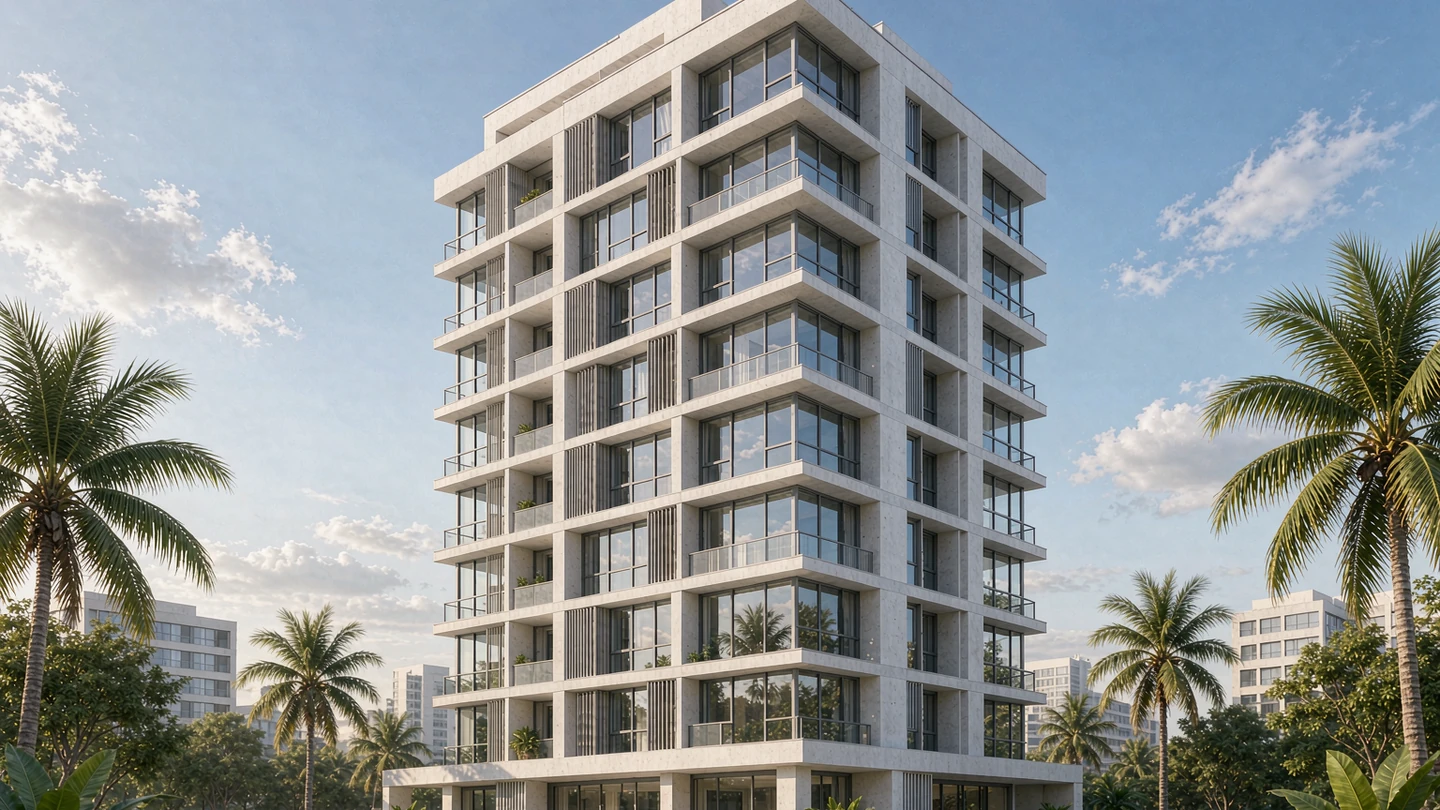
White volumes with deep recessed balconies and vertical sunshades cut the direct sun before it reaches the glass.

villa · day scene
Tropical house, deep roof overhang
Deep roof overhangs shade the sliding doors and keep the terrace usable through the wet season.

villa · day scene
Townhouse, timber screens
A compact two-storey volume around a planted courtyard, with timber screens filtering the street side.
Send your opening schedule
Series, glazing and finish come back as one quotation, with the full dimensional pack on PDF and CAD on request.